
Summary
- Citigroup's shares are still miles below their 2007 high, but, on average, Seeking Alpha contributors are bullish on the stock now.
- One contributor recently made a bearish case for Citigroup, citing the prospect of lower interest rates hurting the bank's net interest income.
- For cautious Citigroup bulls concerned about that, I present ways to stay long the stock while strictly limiting your risk. I close with an explanation of my neutral Citigroup rating.
- Looking for more? I update all of my investing ideas and strategies to members of Bulletproof Investing. Get started today »

Kirk and Spock face a time portal in the Star Trek episode "City On The Edge Of Forever" (image via TrekMovie.com).
Citi On The Edge Of Forever
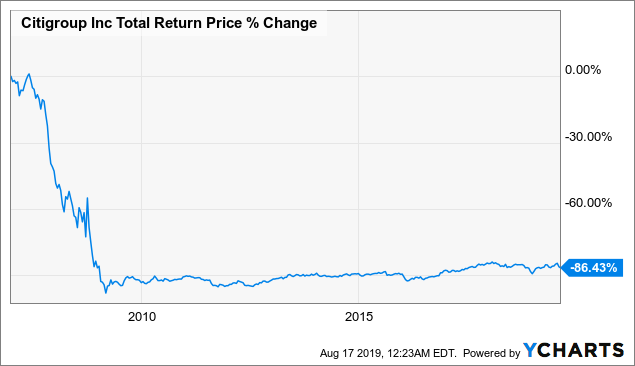
In the best of the original Star Trek episodes ("The City On The Edge Of Forever"), Kirk and Spock find a portal that lets them go back in time. They go back to the 1930s. But most Citigroup (C) shareholders would probably be happy to go back to 2007.
 Data by YCharts
How long until shares of Citi retake those 2007 highs? To a first approximation: forever. Nevertheless, Seeking Alpha contributors are, on average, bullish about the stock now.
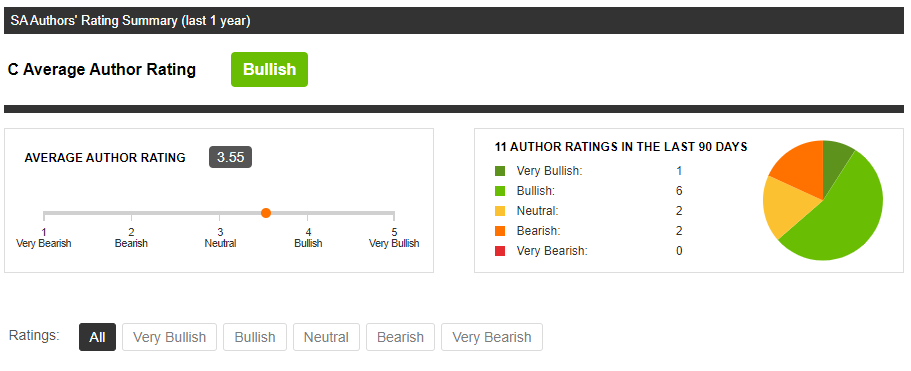
One outlier among contributors here is Achilles Research, who recently advised Citigroup shareholders to "get out while you can". Achilles Research's thesis was that the Fed would lower rates further this year, and lower rates would imperil Citi's net interest income (Readers may recall my recent article about the Direxion Daily 30-Year Treasury Bull 3x Shares ETF (TMF) centered on a similar idea).
For cautious Citigroup bulls, let's look at ways you can stay long the stock while strictly limiting your risk in the event Achilles Research's bearishness proves to have been prescient.
Different Kinds Of Downside Protection For Citigroup
Up to recently when I've posted hedges for securities, I've used expiration dates approximately six months out. That's been my system's default for years, partly out of convenience for investors and partly for the reason Riskalyze CEO Aaron Klein explained here: Investors seem to be better able to conceptualize risk over six-month periods than longer ones. That's still our default, but we've added a new feature that lets users select their own expiration dates.
This raises an interesting question: What's the cheaper way to hedge if you adjust for the different times to expiration? To enable an apples-to-apples comparison, I've highlighted the annualized cost of each C hedge below, two of which expire in December and two of which expire in January of 2021. Each of these hedges is designed for an investor unwilling to risk a decline of more than 20% in his C shares.

